
Why Does a Flag Keep Twisting Around the Pole?
A flag twisting around its pole can result from the way the cloth is connected, restricted movement, changing wind or contact with the surrounding structure. The same visible symptom can therefore have different causes. Start by documenting the installed arrangement instead of immediately adding more clips or buying a larger flag. Any adjustment should follow the instructions for the particular system and be handled through the responsible facilities team when access is required.
Describe when the twisting happens
Note whether the cloth wraps while being raised, after a wind change or repeatedly at the same position. Photograph the flag when it is both hanging normally and twisted, if this can be done from a safe place. Include a wide view showing neighbouring poles, walls and signs. These observations help a supplier understand the problem without asking staff to manipulate a tall installed assembly.
Review the attachment arrangement
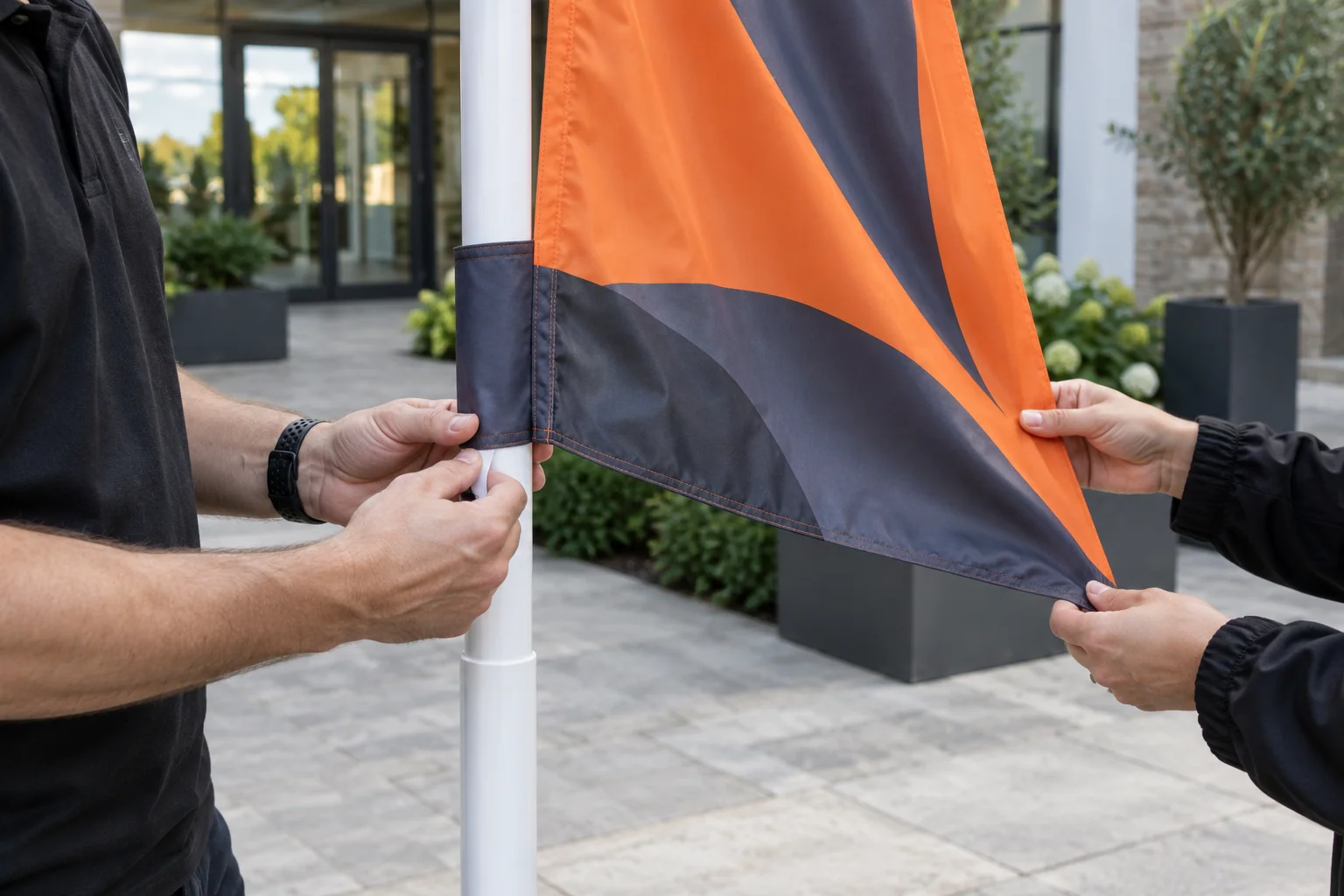
Identify whether the flag has a sleeve, eyelets, clips or a rotating arm. Compare the actual arrangement with the instructions for the pole system. An accessory designed for a different connection may not allow the intended movement. Do not shorten ropes, move fixed components or improvise additional ties until the responsible installer has confirmed what is appropriate for that specific assembly.
Look for obstruction and mismatched dimensions
Check accessible information about the permitted flag size and the cloth currently fitted. A replacement with a different header or sleeve may behave differently even when its printed dimensions are similar. Record any contact with architectural edges or adjacent displays. The facilities team should assess whether clearance or mounting position needs attention, rather than treating every instance of twisting as a fault in the fabric.
Ask about a compatible rotating system
A purpose-designed rotating collar or arm may be an option for a particular pole. Zephyr publishes model-specific instructions and rotating-arm information, showing that compatibility and operating access matter. Request the relevant drawing and limitations before purchasing. No accessory should be presented as eliminating every possible wrap, especially where the underlying location, fabric size or connection remains unsuitable.
Close the loop after any change
Keep a record of the original problem, the approved alteration and the result. For a network of sites, trial one suitable assembly before changing every location. When ordering another flag, retain the correct SKU and attachment specification. Orient Uniforms FZE can review custom flag details and accessible photographs during an enquiry; any hardware supply, fitting work and compatibility must be agreed separately in writing.
Questions & answers
Is twisting always caused by a poor flag?
No. Attachment, clearance and the pole assembly should be reviewed alongside the textile before deciding what needs to change.
Can a heavier flag stop twisting?
Do not assume so. Any size or weight change must remain compatible with the pole and its instructions, and may leave the original cause unresolved.